Newsletter from Onsala Space Observatory |
|
Onsala Space Observatory
Astronomy newsletter | June 2025 |
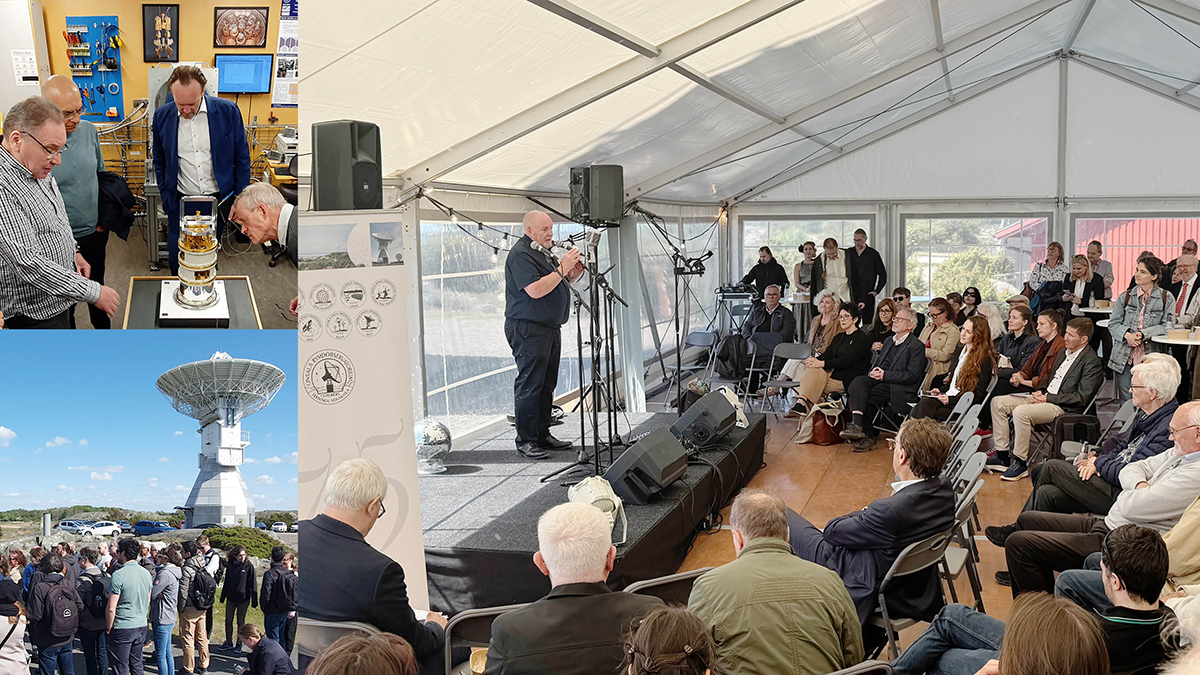
Onsala Space Observatory celebrated 75 years on 15 May 2025. During the day, invited guests visited receiver labs and telescopes. SKAO director Phil Diamond was one of many invited speakers. Credit: Chalmers/MJ Shahhoseini | From the director
Recently Onsala Space Observatory celebrated a significant milestone with a celebration to mark the 75th anniversary of the observatory. This was a great opportunity for our present and former staff, and for invited guests, to meet and share stories of the observatory’s past, experience its present, and look forward to the future. Representatives from leading international astronomy observatories (such as ESO, SKAO and NRAO) and from the Space Geodesy community (for example from GGOS, the Global Geodetic Observing System) attended. All spoke warmly concerning the observatory's many past contributions and important current role within both disciplines. The day began with a tour at the Chalmers Johanneberg campus of the GARD instrumentation facilities and Chalmers' impressive on-site clean room, after which the event moved to Onsala, with a reception held against the backdrop of the OSO telescopes and the sea on a beautiful spring day. I thank everybody who organized and participated in creating a memorable event. John Conway | |
Calls for proposals
APEX. It is not yet decided how much Swedish observing time will be available in 2026 or when the observations will be made. Information about proposal procedures will therefore be issued later. (APEX is a 12 m diameter submillimetre telescope in Chile.) Onsala 20 m telescope. The next Call for proposals is expected to be issued in November 2025 with a deadline in early December 2025. Proposals for observations on director's discretionary time can however be submitted at any time. The telescope is equipped with receivers which provide continuous frequency coverage in the ranges 18-50, 67-87 and 85-116 GHz with 4 GHz IF bandpass, dual polarisations and full mutual sideband rejection (<−13 dB). Director’s discretionary time. Proposals for observations on director's discretionary time with APEX, the Onsala 20 m telescope, and single station observations with the Swedish LOFAR station in Onsala can be submitted at any time (but note that the last Swedish APEX observations for 2025 will be made in early August).
See our web pages for more information.
European VLBI Network. The EVN is a network of radio telescopes located primarily in Europe and Asia. Next deadline 1 October 2025.
The EVN homepage has more information. |
| |
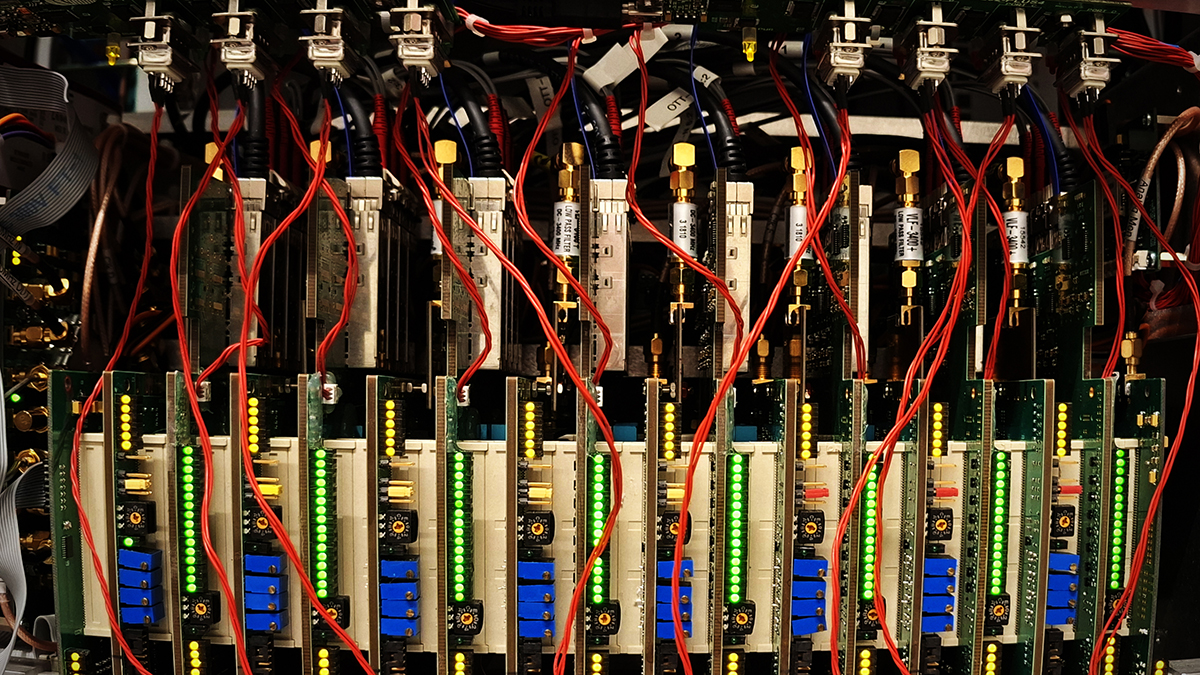
Digital backend for VLBI at Onsala Space Observatory (DBBC3). Credit: Chalmers/R. Cumming |
10th International VLBI Technology Workshop at ChalmersRegistration is open for the 10th International VLBI Technology Workshop (IVTW2025) to be held on 21-25 October 2025. It is hosted by Chalmers University of Technology, Onsala Space Observatory, in Gothenburg, Sweden.
IVTW2025 will bring together experts and researchers from around the world to share the latest developments in VLBI technology. The workshop will cover a broad range of topics, including: station updates, frontend and backend systems, recording and correlation techniques, image processing, potential space VLBI missions RFI monitoring, mitigation, and adaptive strategies in today's rapidly changing environment. In addition, we plan to arrange a visit to the clean room facility at Chalmers campus, used by the Onsala Space Observatory GARD group for receiver development, as well as a visit to the observatory site in Onsala, 45 km from Gothenburg. The workshop is sponsored by Chalmers Space. We look forward to welcoming you to Gothenburg for a week of collaboration and innovation in VLBI technology. Michael Lindqvist and Anne-Kathrin Baczko, on behalf of the SOC and LOC |
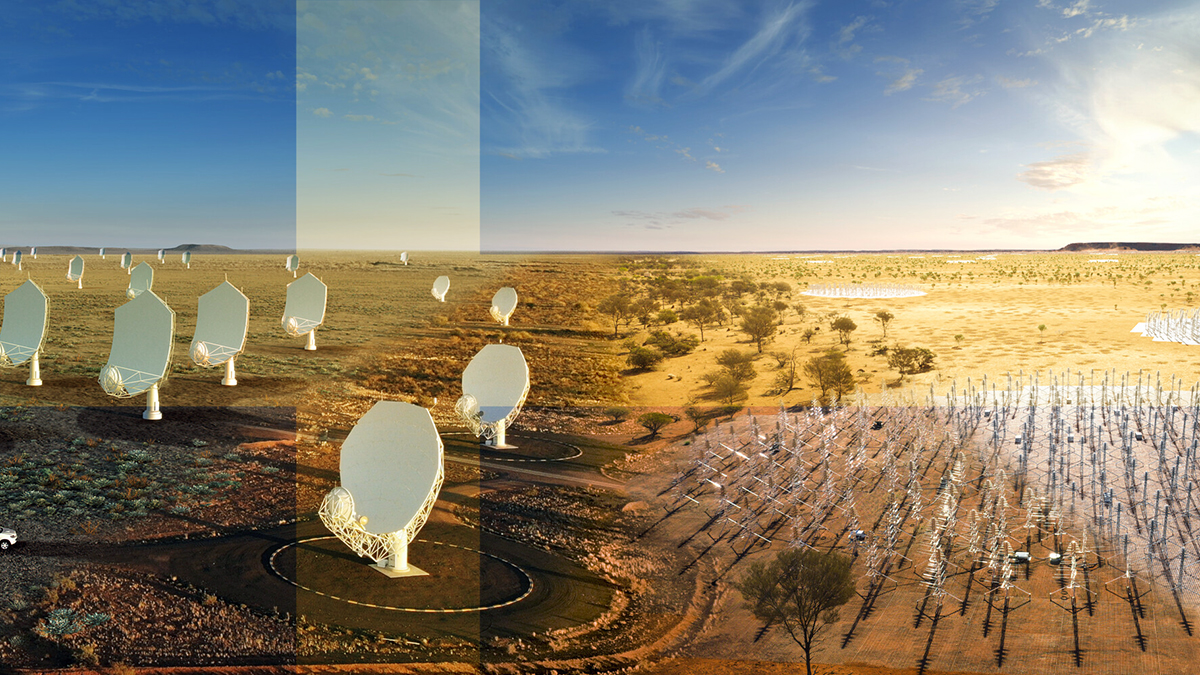
Get ready for the 3rd Swedish SKA Science DaysSweden's third national SKA Science Days will be held in Stockholm during the first week of February (2-6 February, week 6). During the Science Days we'll showcase SKA activities in Sweden, including participation in SKA Science Data Challenges, industry contributions, and the latest from the Swedish node of the SKA Regional Center Network (SWE-SRC see swesrc.org). The meeting follows the second Swedish SKA Science Days, held at Chalmers in Gothenburg in September 2024. You can still see the presentations here. Kelley Hess and Garrelt Mellema, on behalf of the SOC/LOC & SWE-SRC |
Science News Do you have recent science highlights related to telescopes operated or supported by Onsala Space Observatory? Let us know and we'll share in future newsletters!
|
New ways to molecular insights with ALMA
How to deal with the wealth of molecular information from ALMA?
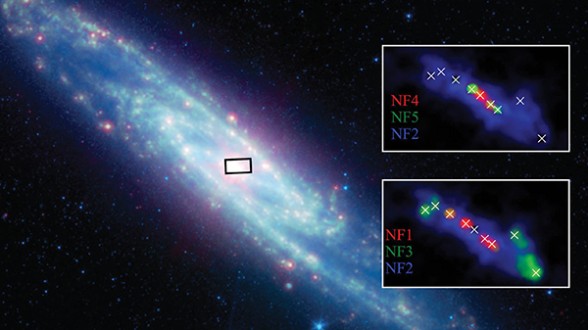
Kishikawa et al (2025) explored the nearby starburst galaxy NGC 253 using NMF - non-negative matrix factorization. Mapping star formation in 44 species and 148 transitions, the study is an important success in advance of the ALMA
wideband sensitivity upgrade.
|
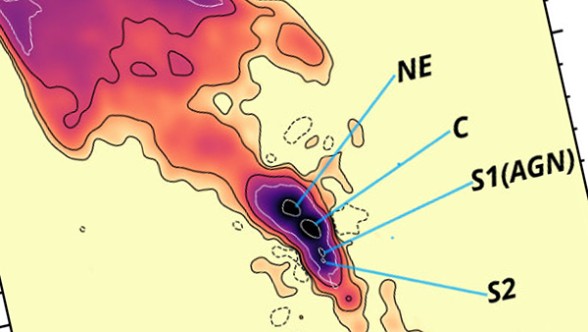
All eyes on NGC 1068 (and its corona)Mutie et al (2025) have put together data from e-MERLIN, VLA, and ALMA to study the radio-quiet Seyfert 2 galaxy NGC 1068. An optically thick synchrotron source known as a corona could explain its unusual spectral energy distribution, the authors find. | | |
Revisiting the radio shell of supernova 1993J
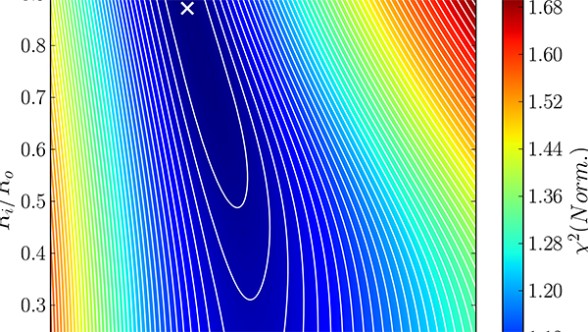
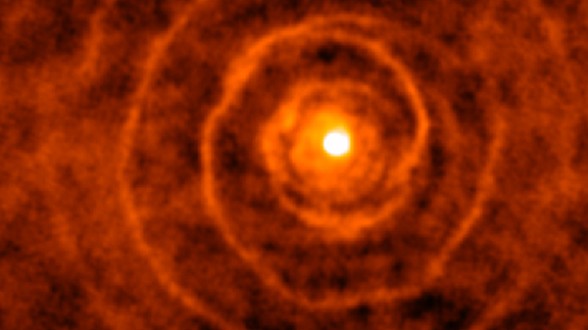
Martí-Vidal et al (2025) have revisited and reanalysed VLBI measurements of the expanding shell from supernova 1993J. Their new analysis is based on physical and instrumental insights. It reveals the radial structure of an expanding spherical shell that's surprisingly similar to the nearby supernova remnant Cassiopeia A. | Charting five carbon stars and their CSIt's not just IRC +10216. Unnikrishnan et al (2025) have studied carbon monosulphide around more carbon stars than the classic one, and yes they are all similar. One is AFGL 3068 pictured here in CO from Kim et al 2017. | | |
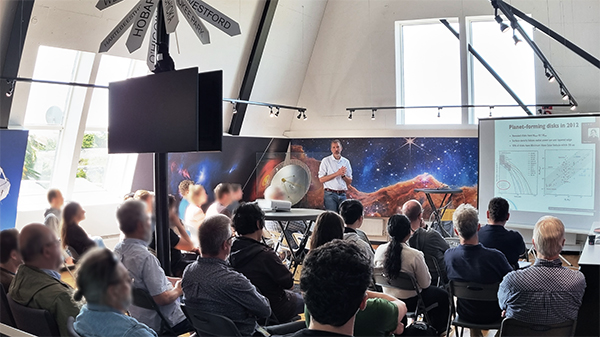
The ALMA Cycle 12 Call for Proposals closed successfully on 24 April. A total of 1693 proposals were submitted, including 44 Large Programs. Stage 2 of the Distributed Peer Review is now underway, with the deadline for reviewers to submit their rankings set for 19 June. On 3 June, the Nordic ARC node hosted the Nordic ALMA Day at the Onsala Space Observatory, bringing together users and instrument developers from all over Sweden to discuss ALMA’s future in light of the upcoming Wideband Sensitivity Upgrade (WSU). The event fostered active exchange between the scientific and technical communities and marked a significant step in engaging the Nordic user base with ALMA’s evolving capabilities. The program featured a keynote seminar by Michiel Hogerheijde (Leiden University), who highlighted the scientific advances in star and planet formation made possible by ALMA over the past decade and the transformative potential of the WSU. Participants also presented contributed talks on topics ranging from submillimetre HCN lasers in AGB stars to dust detections in the early universe and receiver development progress. The day concluded with open discussions on Guaranteed Time Observations (GTO) and GARD’s role in ALMA’s instrumentation roadmap. Building on these discussions, a follow-up meeting was held on 4 June at Chalmers to further explore opportunities for potential ALMA GTO time, in connection with GARD’s proposed contribution of an upgraded Band 7 receiver. This initial meeting laid the groundwork for future planning and community input, emphasising how different funding scenarios could influence access to future observing time. For support using ALMA or the ALMA Science Archive: write to us at
contact@nordic-alma.se or visit nordic-alma.se. Subscribe to our mailing list to receive further ALMA news.
Sabine König & Daniel Tafoya, Chalmers, on behalf of the Nordic ARC node |
Michiel Hogerheijde on stage at the ALMA day, held at the visitor centre in Onsala. Credit: Chalmers/D. Tafoya | | |
Support at Onsala Space Observatory
|
Onsala Space Observatory offers a wide variety of
support to Swedish astronomers. We host the Nordic ALMA node, and offer support in several
other areas.
|
Data Reduction: We support the reduction
of all types of radio/(sub-)mm interferometric
and single-dish observations. We welcome
visitors who need reduction support and offer
them the use of our National Facility
Computing Infrastructure (NaFCI) for
reduction of large data sets. Specialised Courses: We will be able to
assist with specialised lectures on for example,
interferometry, radio/(sub-)mm data analysis
and/or the use of National Facility instruments.
|
Student projects: We also encourage visits
by students who want to learn how to reduce
and analyse their radio/(sub-)mm observations.
Workshop/School support: Similarly,
we can assist in planning and lecturing at
schools or workshops, when these include
topics related to National Facility activities and
instruments. This includes but is not limited to,
for example, radio/(sub-)mm interferometry
and single dish observing and analysis, ALMA,
APEX, LOFAR, SKA and EVN, plus our small SALSA telescopes for schools, students and the public. Seminars: National facility staff are also
available for scientific and technical seminars
on the aforementioned instruments. Michael Lindqvist, Chalmers
|
|
Tell your colleagues about us! Onsala Space Observatory Astronomy Newsletter informs the astronomical community of current and planned instruments, support opportunities, and scientific highlights. It's published twice per year. Please encourage your colleagues to join us! Signing up is the best way of ensuring the newsletter gets to your inbox and nowhere else. Robert Cumming, editor, robert.cumming@chalmers.se
|
|
|
| | CHALMERS TEKNISKA HÖGSKOLA AB - 412 96 GÖTEBORG
031-772 10 00 - WWW.CHALMERS.SE | |
|
|