Newsletter from Onsala Space Observatory |
|
Onsala Space Observatory
Astronomy newsletter | January 2026 |
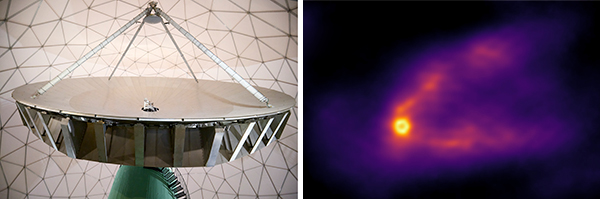
Birthday portrait of the 20-m telescope (left) and the GMVA's image of M87* and its jets. Credit: Chalmers/Anna-Lena Lundqvist; MPIfR/Jongseo Kim et al (2025) | From the director
This year marks 50 years since the inauguration of our 20-metre telescope in 1976. A visionary leap into the emerging field of millimetre-wave radio astronomy, the telescope remained the world’s largest instrument of its kind for nearly a decade. It laid the foundation for OSO’s key role in establishing millimetre astronomy in Chile through involvement in SEST, APEX, and ALMA. The 20-m telescope has also been OSO’s geodetic VLBI workhorse, producing the world’s longest continuous data series. Today it continues to make frontline contributions to millimetre astronomy, including global VLBI efforts that have delivered the first images of a supermassive black hole’s shadow and the collimation of its relativistic jet. Thanks to a generous 13 MSEK donation from the Hasselblad Foundation, construction will soon begin on a new tri-band camera enabling simultaneous observations at three frequencies. This will revolutionise the telescope’s VLBI performance via reducing atmospheric phase fluctuations by an amount equivalent to moving the telescope to a 2700 m-high mountain. Key technology developed at OSO will make this instrument the most sensitive of its kind in the world.John Conway | |
Calls for proposals
Onsala 20 m telescope. Proposals are invited for observations with the Onsala 20 m diameter telescope in the observing period March-December 2026. Proposals for observations on director's discretionary time can however be submitted at any time. The telescope is equipped with receivers which provide continuous frequency coverage in the ranges 18-50, 67-87 and 85-116 GHz with 4 GHz IF bandpass, dual polarisations and full mutual sideband rejection (<−13 dB). Before submitting the proposal, the authors must contact the telescope scientist Henrik Olofsson (henrik.olofsson@chalmers.se) to arrange with a local collaborator to support the observations. Proposals are to be submitted through the NorthStar system. Deadline: 16 February 2026 (23:59:59 UTC).
See our web pages for more information
APEX. APEX is a 12 m diameter submillimetre telescope in Chile. The next Call for proposals for single-dish observations with APEX will be for science verification observations with the new 345 GHz receiver, and is expected to be issued in the spring of 2026. Director’s discretionary time. Proposals for observations on director's discretionary time (DDT) can be submitted at any time (for observations with the Onsala 20 m telescope). The Swedish LOFAR station in Onsala is being upgraded during 2026, and is currently not available for DDT proposals (otherwise, it is normally available for single station DDT proposals). APEX is not available for DDT proposals.
See our web pages for more information.
European VLBI Network. The EVN is a network of radio telescopes located primarily in Europe and Asia. Next deadline 1 February 2026.
The EVN homepage has more information. |
| |
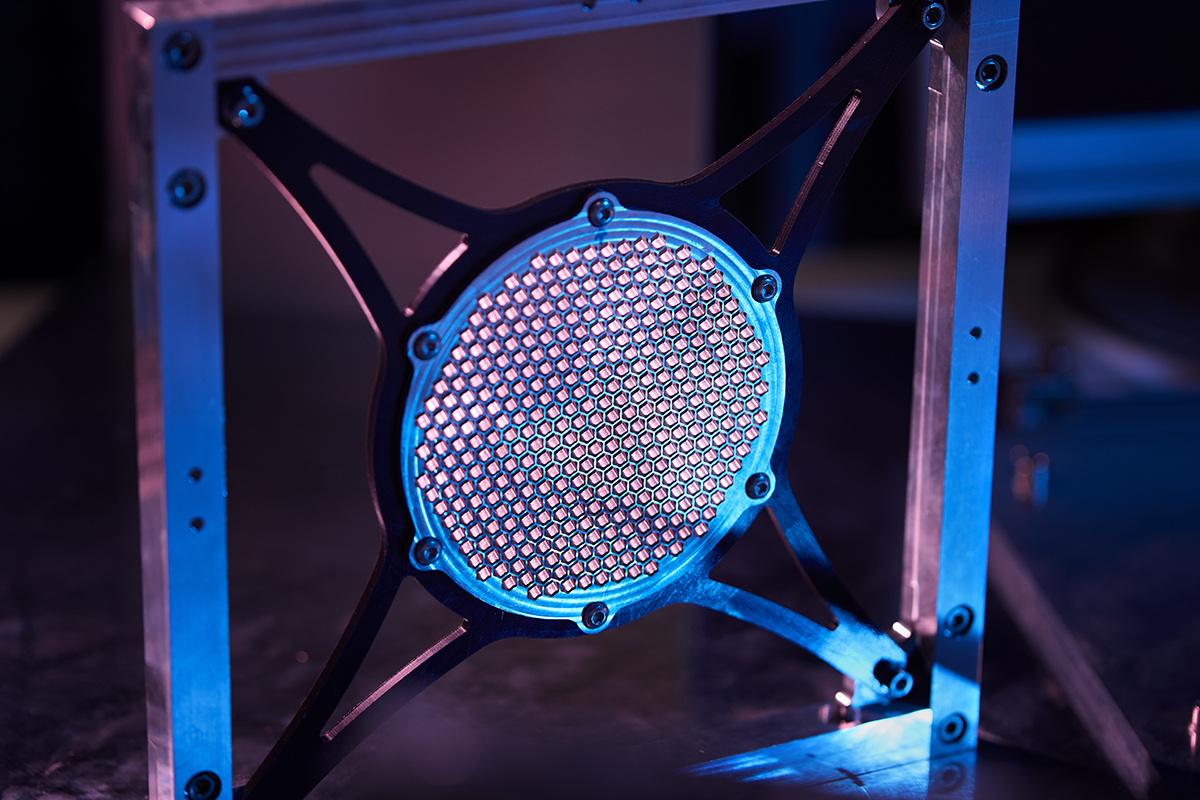
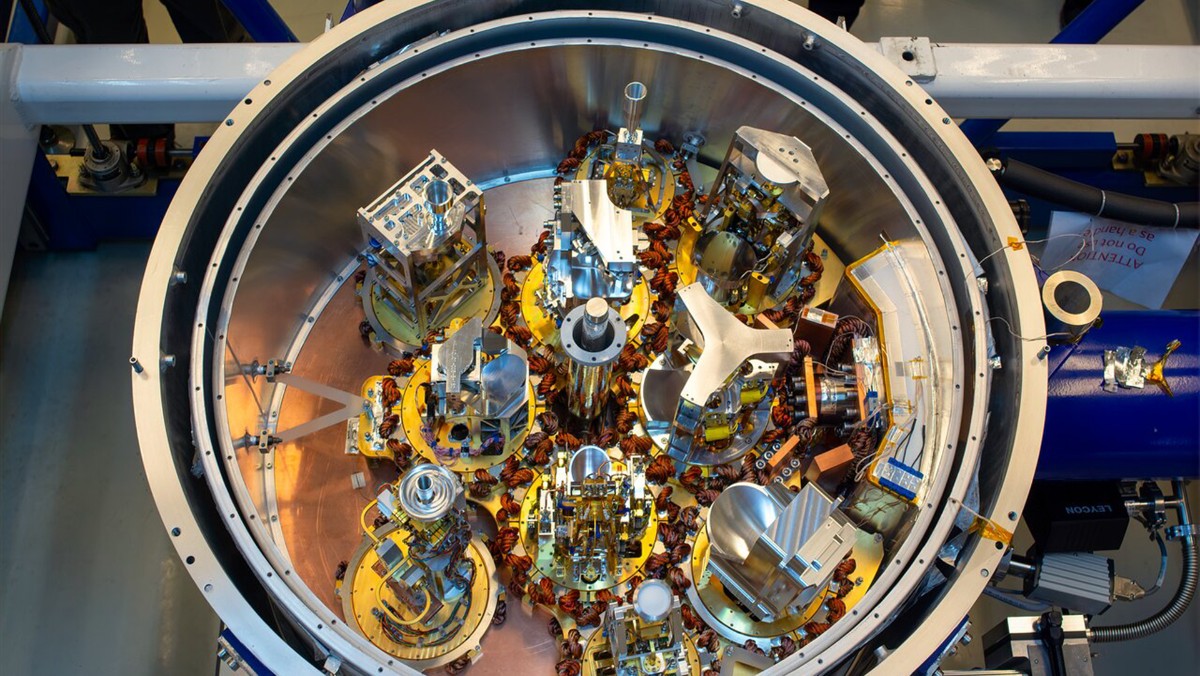
Dichroic for the new tri-band camera in GARD's lab in Gothenburg. Credit: Chalmers/Anna-Lena Lundqvist |
New tri-band camera will enable high-quality VLBI observationsOnsala Space Observatory has received 13 million SEK from the Hasselblad Foundation to build a new camera for the Onsala 20-m radio telescope.
The new three-band camera is part of a global initiative to enable high-quality, multi-colour images of black holes and other phenomena, using frequency phase transfer (FPT) as developed in South Korea. “This grant opens up exciting possibilities. Our new three-band camera will be a very different instrument than the Hasselblad cameras that took pictures on the Moon, but for us the goal is the same. We want to develop world-leading technology to image and understand phenomena in space”, says John Conway, director of the Onsala Space Observatory. |
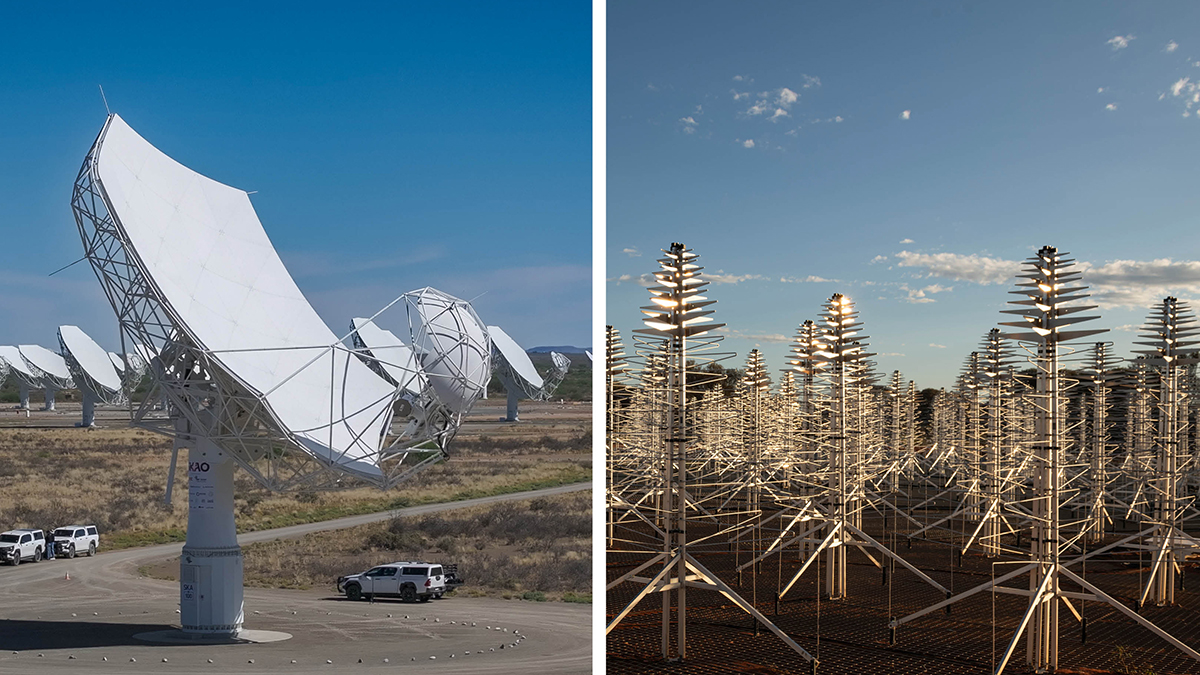
New antennas in SKA-Mid in South Africa (left) and SKA-Low in Australia (right). Credit: SKAO; SKAO/Max Alexander |
Join us at the 3rd Swedish SKA Science DaysSweden's third national SKA Science Days will be held in Stockholm during the first week of February (4-5 February, week 6).
During the Science Days we will hear about the latest updates from SKAO and the SKA Regional Center Network, emphasizing the timeline for science operations.
The conference will feature a number of distinguished international speakers, and the largest number of contributed talks at these Science Days to date. The presentations will showcase SKA activities in Sweden, including participation in SKA Science Data Challenges, industry contributions, science with SKA precursors, and discussions about applying machine learning techniques to SKA-scale data. For program and registration, see the conference homepage. Kelley Hess and Garrelt Mellema, on behalf of the SOC/LOC &
SWE-SRC |
Science News Do you have recent science highlights related to telescopes operated or supported by Onsala Space Observatory? Let us know and we'll share in future newsletters!
|
ALMA reveals galaxies' secrets with hydrogen sulphide
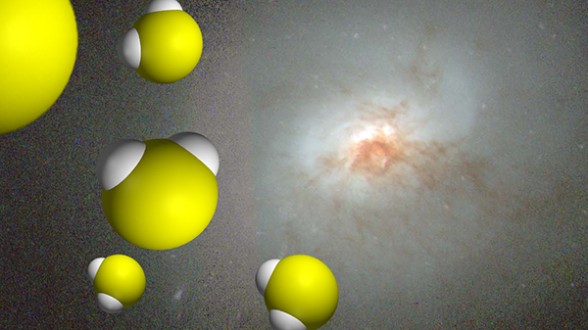
Sato et al (2025) used ALMA to measure hydrogen sulphide molecules in three nearby luminous infrared galaxies. H2S turns out to be useful for investigating the what really goes on in galactic nuclei and outflows. (Image: NGC 1266, HST, NASA/ESA) | Resolving molecular gas in lensed galaxies with ALMA
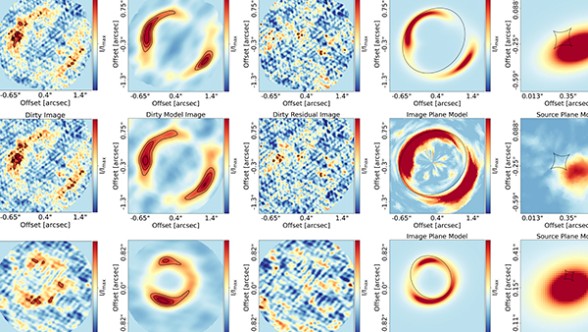
Kade et al (2025) used ALMA to map two gravitationally lensed starburst galaxies at redshift 2.5-2.8 - SPT 0125-47 and SPT 2134-50. By looking in CO(3-2), they were able to search for explanations for their prodigious star formation rates.
| An even better CMB temperature at redshift 0.89
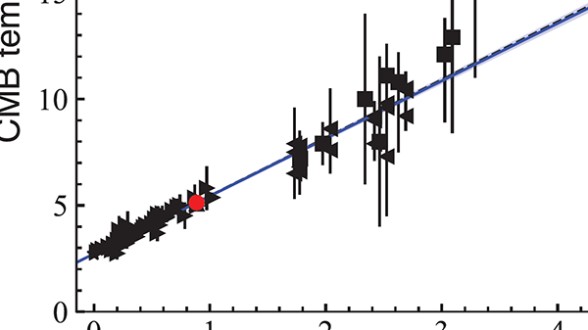
Kotani et al (2025) used ALMA, lines of HCN and the lensed quasar PKS 1830-211 to make a new, improved estimate of the temperature of the cosmic background 7.2 billion years ago (spoiler: 5.13 ± 0.06 K).
| | |
Repeating bursts give clues to FRB energetics
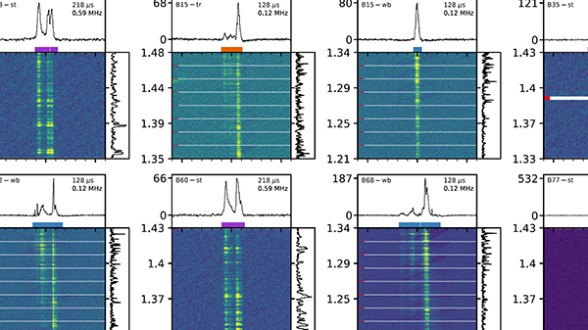
Ould-Boukattine et al (2025) used FRB 20220912A, a prolific source of fast radio bursts, to study how these mysterious sources budget their energy, using Onsala's 25-m telescope and colleagues in Westerbork, Stockert and Torun.
|
Which is the methanol maser line in Onsala 1?
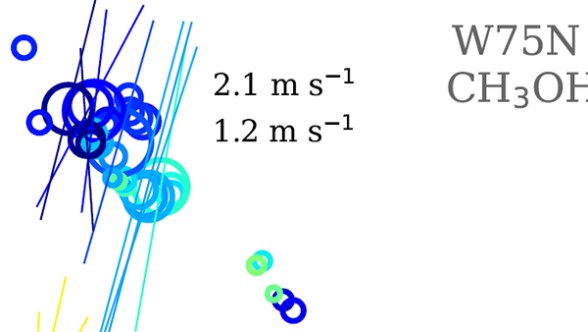
Kobak et al (2025) used the EVN (including the Onsala 25-m) to study maser sources W75N and Onsala 1. Identifying the hyperfine transition responsible for the maser light could enable better magnetic field measurements.
| Millimetre VLBI constrains NGC 1052's jets
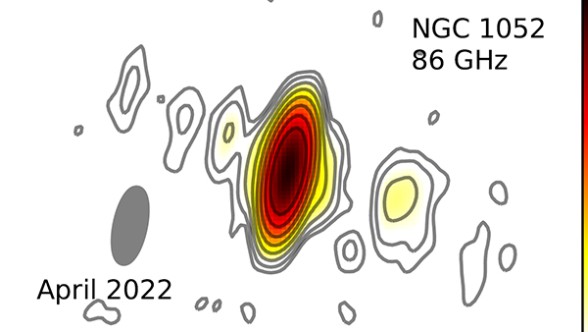
Ricci et al (2025) used the Global Millimetre VLBI Array (including telescopes in Onsala) to put new contraints on the centre of the famous galaxy NGC 1052, whose black hole and twin jets are targets for the Event Horizon Telescope. | | |
ALMA Cycle 11 concluded on 1 October with an outstanding operational achievement, setting a new all-time record in the delivery of science-quality observing hours (QA0 PASS observations) across all three arrays. During the cycle, the 12m Array delivered 4496 hours of science-quality data, surpassing for the first time the ambitious target of 4300 hours. In parallel, 4201 hours were obtained with the 7m Array, and 3240 hours with the Total Power Array. Building on the success of Cycle 10, this milestone highlights the continued maturity and efficiency of ALMA operations and reflects the dedication and teamwork of observatory staff across the entire ALMA partnership. With the conclusion of Cycle 11 on 1 October, ALMA Cycle 12 began. From the Nordic countries region, 23 proposals were accepted for observations in Cycle 12, including 12 led by Sweden, eight by Denmark, two by Finland, and one by Norway. This outcome reflects strong and sustained engagement from the Nordic ALMA user community and its continued scientific use of ALMA. Several important updates for users were also announced in late 2025. As of 1 October, ALMA implemented an updated policy for Director’s Discretionary Time (DDT) proposals, whereby approved DDT data are released publicly upon delivery by default, with an optional proprietary period of up to six months available only in exceptional cases. In addition, Science Verification observations with the new Band 2 receivers were successfully carried out in November, targeting G31.41+0.31, Arp 220, SPT 0027–50, and HR 5907. In December, a dedicated busy-week at ESO was devoted to an intensive quality assessment of these data, which were found to be of very high quality. The resulting Science Verification data are expected to be released to the wider astronomical community in the coming weeks. For support using ALMA or the ALMA Science Archive: write to us at
contact@nordic-alma.se or visit nordic-alma.se. Subscribe to our mailing list to receive further ALMA news.
Daniel Tafoya and Sabine König, Chalmers, on behalf of the Nordic ARC node |
ALMA receivers, among them Band 5 and new Band 2 cartridges both designed by Onsala's GARD group. Credit: NOVA/ESO | | |
Support at Onsala Space Observatory
|
Onsala Space Observatory offers a wide variety of
support to astronomers in Sweden. We host the Nordic ALMA node, and offer support in several
other areas.
|
Data Reduction: We support the reduction
of all types of radio/(sub-)mm interferometric
and single-dish observations. We welcome
visitors who need reduction support and offer
them the use of our National Facility
Computing Infrastructure (NaFCI) for
reduction of large data sets. Specialised Courses: We will be able to
assist with specialised lectures on for example,
interferometry, radio/(sub-)mm data analysis
and/or the use of National Facility instruments.
|
Student projects: We also encourage visits
by students who want to learn how to reduce
and analyse their radio/(sub-)mm observations.
Workshop/School support: Similarly,
we can assist in planning and lecturing at
schools or workshops, when these include
topics related to National Facility activities and
instruments. This includes but is not limited to,
for example, radio/(sub-)mm interferometry
and single dish observing and analysis, ALMA,
APEX, LOFAR, SKA and EVN, plus our small SALSA telescopes for schools, students and the public. Seminars: National facility staff are also
available for scientific and technical seminars
on the aforementioned instruments. Michael Lindqvist, Chalmers
|
|
Tell your colleagues about us! Onsala Space Observatory Astronomy Newsletter informs the astronomical community of current and planned instruments, support opportunities, and scientific highlights. It's published twice per year. Please encourage your colleagues to join us! Signing up is the best way of ensuring the newsletter gets to your inbox and nowhere else. You can also follow Onsala Space Observatory on LinkedIn. Robert Cumming, editor, robert.cumming@chalmers.se
|
|
|
| | CHALMERS TEKNISKA HÖGSKOLA AB - 412 96 GÖTEBORG
+46 31 772 1000 - WWW.CHALMERS.SE | |
|
|