Newsletter from Onsala Space Observatory |
|
Astronomy newsletter
June 2026 | | | | | | | | | |
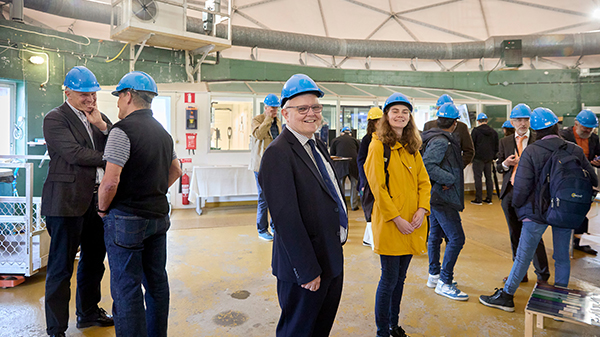
| Guests in the
20 metre telescope's radome during the 50th anniversary celebration in May, among them John Conway (centre), PhD student Alva Kinman (in yellow), (leftmost) Hasselblad Foundation CEO Kalle Sanner and professor emeritus Gunnar Elgered. Photo: Chalmers/Anna-Lena Lundqvist
| |
Onsala Space Observatory had much to celebrate in May at an event to mark the 50th anniversary of our 20 m telescope. The 13 MSEK Hasselblad Foundation-funded project to build a new triple band receiver, for example, was described in the last newsletter. In addition, the Swedish Research Council VR's grant for our astronomy activities for 2027 - 2030 has now also been finalised, with a very positive outcome for the observatory. The proposal evaluation gave an overall assessment of "Truly outstanding", with the highest possible grades in nearly every assessment category. After a series of dialogue meetings with the research council, the award was finalised in March this year at a level close to the full amount requested. This result provides a stable base for the observatory’s development plans for the coming years. It's also a testament to the hard work and creativity of our staff and to the support of our users. Thank you!
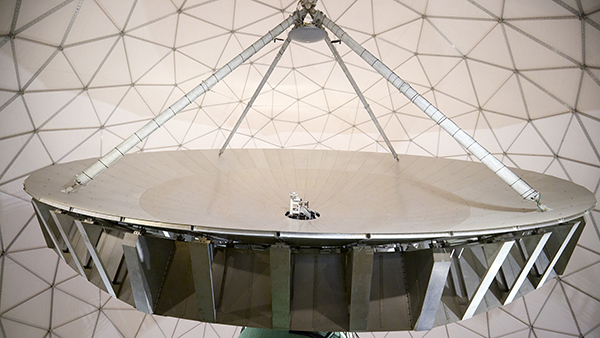
John Conway | | | | The Onsala 20 m telescope. Photo: Chalmers/Anna-Lena Lundqvist
|
Onsala 20 m telescope. The next Call for proposals is expected to be issued late 2026 or early 2027. See our web pages for more information.
APEX. APEX is a 12 m diameter submillimetre telescope in Chile. The next Call for proposals for single-dish observations with APEX will be for science verification observations with the new 345 GHz receiver, and is expected to be issued after the summer of 2026. See our web pages for more information. Director’s discretionary time. Proposals for observations on director's discretionary time (DDT) can be submitted at any time (for observations with the Onsala 20 m telescope). The Swedish LOFAR station in Onsala is being upgraded during 2026, and is currently not available for DDT proposals. APEX is not available for DDT proposals. See our web pages for more information.
European VLBI Network. The EVN is a network of radio telescopes located primarily in Europe and Asia. Next deadline is 1 October 2026. The EVN homepage has more information.
| | |
Onsala is ready for LOFAR 2.0 | | | |
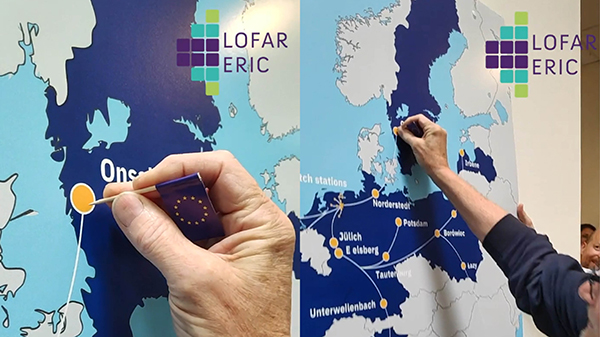
Europe's biggest radio telescope is undergoing a major upgrade. A ceremony in the Netherlands (photo) marked a big milestone, when Sweden's station in LOFAR became the first international station to be upgraded to LOFAR 2.0. The new, much more sensitive telescope will make the world's most detailed maps of the low-frequency radio sky, and will study phenomena from lightning and space weather to the early universe.
| | | | Credit: Chalmers/R. Cumming
|
Relive the 3rd Sweden SKA Days | | |
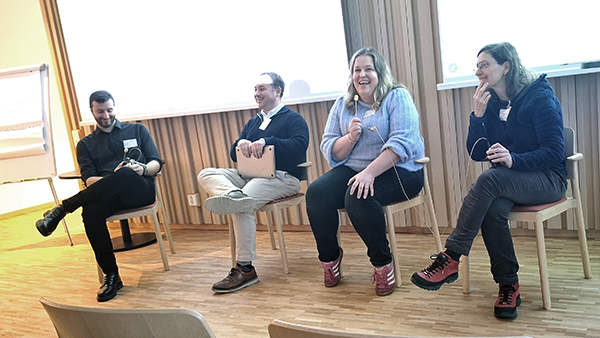
On Swe-SRC's web pages you can read a report on the SKA Days in Stockholm earlier this year
- you can also access the presentations. The photo above shows the panel discussion on AI and machine learning (from left: Michele Bianco, Jens Jasche, Shari Breen and Carmen Toribio).
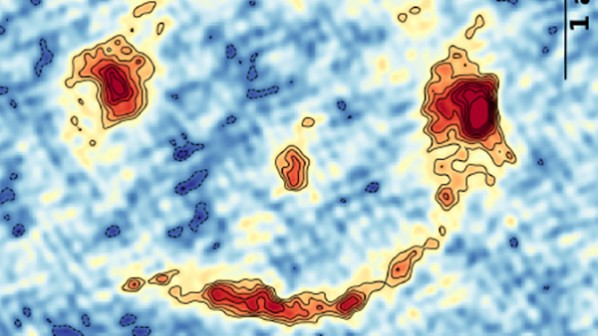
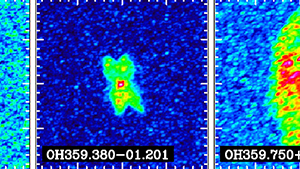
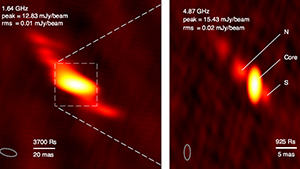
For more news, sign up to the SKA Sweden mailing list. Write to ska.sweden@chalmers.se. | | | | | Kade et al. (2026) used ALMA to map gas and dust in the lensed starburst galaxy G09v1.97, revealing a rotating disk, signs of interaction - and a smile. | | | | | | Olofsson et al (2026) surveyed over 70 OH/IR stars in the galactic bulge with ALMA, a new foundation for future studies. Some have extended, complex structure (pictured). | | | | | | | | | | | | Jet from a sleeping black hole | Using the EVN, Cheng et al. (2026) found a surprising double-sided jet from the black hole in the centre of galaxy Messier 60. | | | | | | Molecules from a hyperactive comet
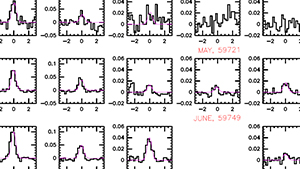
| Kirsanova et al. (2026) combined the Onsala 20 m telescope and APEX to measure the molecular production of comet C/2017 K2 (PanSTARRS).
| | | | | | | | | |
Band 2 science verification data are now publicly available through the ALMA Science Portal. These observations, obtained in November 2025, mark an important step in the commissioning of the new Band 2 receiver system, which opens access to the 67–116 GHz frequency range and provides new opportunities for studies of molecular gas, star formation, astrochemistry, polarisation, and extragalactic sources. The datasets include observations of G31.41+0.31, SPT 0027–50, HR 5907, and Arp 220, demonstrating key capabilities including spectral-line scans, imaging of chemically rich sources, observations of high-redshift galaxies, and full-polarisation measurements.
Record proposals. ALMA time is still under very high demand. The Cycle 13 call set a new record, with 1843 submitted proposals requesting more than 37000 hours on the 12-m Array, plus a record number of Large Programs and 91 Joint Proposals. The number of refereed publications based on ALMA data has now passed 5000, showing ALMA's impact on everything from nearby star and planet formation to the study of galaxies in the early Universe.
ALMA day in Onsala. We were pleased with the strong engagement at our ALMA Day on June 2. Users and ARC staff met for a productive day of talks, discussions, and exchange of experience. Neil Phillips presented the new Band 2 capabilities and Europe’s contribution to the Wideband Sensitivity Upgrade. Thanks to everyone
the Nordic ALMA community for such a stimulating day!
For support using ALMA, preparing proposals, or working with the ALMA Science Archive, write to us at contact@nordic-alma.se or visit nordic-alma.se. Subscribe to our mailing list to receive further ALMA news.
Daniel Tafoya and Sabine König, Chalmers, on behalf of the Nordic ARC node | | |
Onsala Space Observatory offers a wide variety of support to astronomers in Sweden. We host the Nordic ALMA node, and offer support in several other areas. Data Reduction: We support the reduction of all types of radio/(sub-)mm interferometric and single-dish observations.
We welcome visitors who would like hands-on data reduction support.
We offer computing resources through the newly established Compute Infrastructure at Onsala for Radio Astronomy (CIORA) for reduction and analysis of large data sets. You can request access to CIORA via an online form.
Specialised Courses: We will be able to assist with specialised lectures on for example, interferometry, radio/(sub-)mm data analysis and/or the use of National Facility instruments. Student projects: We also encourage visits by students who want to learn how to reduce and analyse their radio/(sub-)mm observations. Workshop/School support: Similarly, we can assist in planning and lecturing at schools or workshops, when these include topics related to National Facility activities and instruments. This includes but is not limited to, for example, radio/(sub-)mm interferometry and single dish observing and analysis, ALMA, APEX, LOFAR, SKA precursors/pathfinders, and EVN, plus our small SALSA telescopes for schools, students and the public.
Seminars: National facility staff are also available for scientific and technical seminars on the aforementioned instruments.
Michael Lindqvist, Chalmers | | | | | |
Follow Onsala
Space Observatory
and Chalmers on | | | | | | | chalmers UNIVERSITY OF TECHNOLOGY ab
412 96 GOTHENBURG
phone: +46 (0)31 772 10 00
www.chalmers.se | | | | | You're receiving this because you've previously signed up for the Onsala Space Observatory Astronomy Newsletter. Contact: Robert Cumming, +46 (0)31 772 5500, robert.cumming@chalmers.sePublisher: Robert Cumming | | | | | | | | | |
|
|